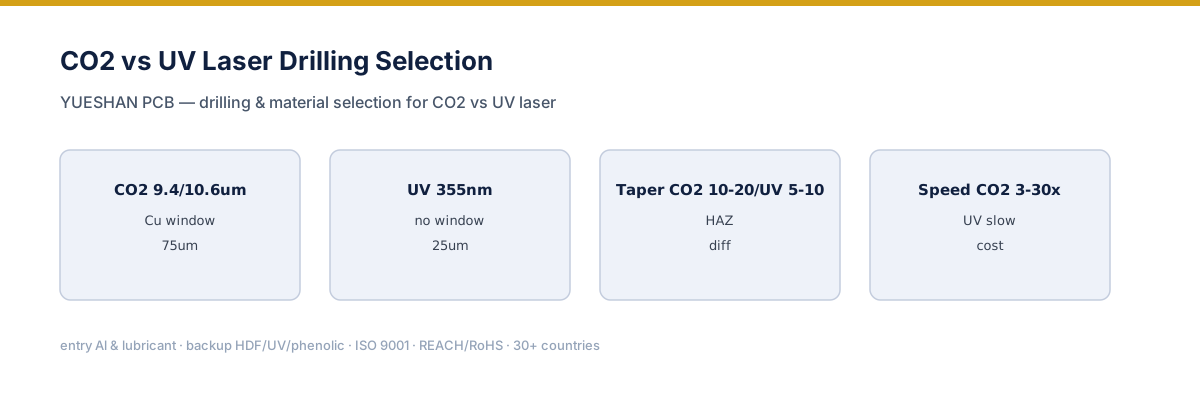
Short answer: Pick the laser by what the board needs: CO2 (9.4/10.6 um) is absorbed by dielectric but reflected by copper, so it needs a pre-etched window, reaches about 75 um, has 10-20 percent taper and cheaper equipment; UV (355 nm) is absorbed by both copper and dielectric, goes down to about 25 um with 5-10 percent taper but runs 3-10x slower and costs more. Most HDI stacks use both.
Number: CO2 (9.4/10.6 um) needs a copper window, minimum about 75 um, taper 10-20 percent, HAZ 10-25 um, 500-3000 holes/s, lower equipment cost. UV (355 nm) needs no window, minimum about 25 um, taper 5-10 percent, HAZ 3-10 um, 100-500 holes/s (3-10x slower), higher equipment cost (atlaspcb, gopcba, maigoo).
Boundary: Laser choice is about the via, not the entry/backup board; the material set still affects stack flatness and window definition. Laser and mechanical drilling are complementary.

CO2 and UV lasers are not interchangeable — they ablate different things. The right choice comes down to what the via looks like and how much you will pay per hole.
Selection matrix
| Factor | CO2 (9.4/10.6 um) | UV (355 nm) |
|---|---|---|
| Copper | Reflected — needs window | Absorbed — no window |
| Min aperture | ~75 um | ~25 um |
| Taper | 10-20 percent | 5-10 percent |
| HAZ | 10-25 um | 3-10 um |
| Speed | 500-3000 holes/s | 100-500 holes/s |
| Equipment cost | Lower | Higher |
Use CO2 for cost-sensitive HDI blind vias with a defined copper window; use UV for the finest, copper-direct microvias in advanced packaging. For the mechanics see the CO2 page and UV page.