Home / Blog / CO2 Laser Drilling & Entry Support

CO2 Laser PCB Drilling and Entry Support

CO2 Laser Drilling · 2026-10-31 · 7 min read

Short answer: CO2 lasers (9.4/10.6 um infrared) are absorbed by the organic dielectric but reflected by copper, so you either pre-etch a copper window or use a conformal mask; the underlying copper acts as a natural stop for blind vias. Use CO2 for HDI blind vias down to about 75 um at 500-3000 holes/s, and keep mechanical drilling for larger through-holes.

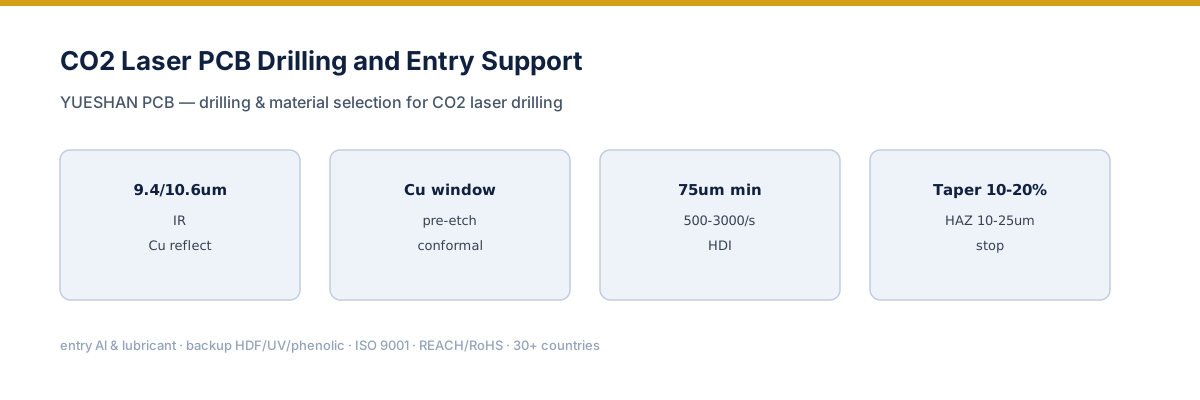
Number: CO2 lasers run at 9.4 or 10.6 um; because copper reflects IR, the process needs a pre-etched copper window or conformal mask, with the copper plane as a natural stop. Typical output is 500-3000 holes/s, minimum about 75 um, taper 10-20 percent and HAZ 10-25 um; equipment cost is lower than UV laser (atlaspcb, fastturnpcbs).

Boundary: A laser drills the dielectric; the entry/backup board question barely applies to pure laser ablation, but the copper window definition and stack flatness still matter. Laser and mechanical are complementary, not competing — most HDI stacks use both.

CO2 laser PCB drilling blind via copper window entry support HDI — YUESHAN
CO2 laser drilling an HDI blind via with a pre-etched copper window.

CO2 laser drilling is the workhorse for HDI blind vias: fast, mature and cheap relative to UV. But it only removes the organic dielectric — copper bounces the beam back — so the process is really about where you let the laser land.

Why copper needs a window

The 9.4/10.6 um CO2 wavelength is absorbed by the resin/glass dielectric but reflected by copper. That is both a limitation and a feature:

CO2 envelope

MetricTypical
Wavelength9.4 / 10.6 um (IR)
Throughput500-3000 holes/s
Minimum apertureabout 75 um
Taper10-20 percent
HAZ10-25 um
Equipment costLower than UV laser

Where the material set still matters: a flat, clean stack and well-defined copper window keep the via centered and the stop reliable. For finer, copper-direct features see the UV laser microvia page and the CO2 vs UV selection matrix.
CO2 laser drilling mechanism diagram
IR absorption, copper window and natural stop.
Process">HDI

HDI & IC Substrate

blind via drilling

HDI →
Laser">CO2

CO2 vs UV

selection matrix

matrix →
Laser">UV

UV Microvia

copper-direct via

UV →
Pillar">Drilling

Mastering PCB Drilling

mechanical vs laser

pillar →
← Back to Blog Request Free Samples →

Frequently Asked Questions

YUESHAN supplies the flat, clean stacks used for HDI blind-via laser drilling. The questions below cover how CO2 lasers work, the copper-window requirement and where mechanical drilling wins.

How does CO2 laser drilling actually work?

CO2 at 9.4/10.6 um is absorbed by the organic dielectric but reflected by copper, so you pre-etch a copper window or use a conformal mask; the copper plane below acts as a natural stop (atlaspcb, fastturnpcbs).

What is the smallest via a CO2 laser can drill?

About 75 um, at 500-3000 holes/s, with 10-20 percent taper and 10-25 um HAZ; equipment cost is lower than UV laser (atlaspcb, fastturnpcbs).

Do you need a copper window for CO2 laser drilling?

Yes — because copper reflects infrared, the dielectric must be exposed via pre-etch or conformal mask; the underlying copper then stops the via at the next layer.

Is CO2 better than mechanical drilling for blind vias?

For HDI blind vias below mechanical limits, CO2 is faster and cheaper; larger through-holes stay mechanical. The two are complementary in a real stack.

Does the entry or backup board matter in laser drilling?

The board question barely applies to pure ablation, but a flat stack and well-defined copper window keep the via centered and the natural stop reliable.

Do you supply laser-drilling support materials?

YUESHAN supplies the aluminum entry and backup that keep HDI stacks flat; the laser tool is selected by the fabricator. Request a sample.

LX

Mr. Lucky Xu — Director, YUESHAN PCB — Director, YUESHAN PCB

15 years in PCB drilling consumables. Wrote and technically reviewed this page; where a number is stated, the page says how it was measured, and any third-party or industry reference (IPC, Rogers, ISO, FDA, PCD tooling, CO2/UV laser, jiepei, hilelectronic, linkut) is named inline rather than presented as a YUESHAN specification.

About the author · Editorial standards & review process · Request TDS / SDS or a sample