Home / Blog / CO2 vs UV Laser Drilling

CO2 vs UV Laser Drilling Selection

CO2 vs UV Laser · 2026-10-31 · 7 min read

Short answer: Pick the laser by what the board needs: CO2 (9.4/10.6 um) is absorbed by dielectric but reflected by copper, so it needs a pre-etched window, reaches about 75 um, has 10-20 percent taper and cheaper equipment; UV (355 nm) is absorbed by both copper and dielectric, goes down to about 25 um with 5-10 percent taper but runs 3-10x slower and costs more. Most HDI stacks use both.

Number: CO2 (9.4/10.6 um) needs a copper window, minimum about 75 um, taper 10-20 percent, HAZ 10-25 um, 500-3000 holes/s, lower equipment cost. UV (355 nm) needs no window, minimum about 25 um, taper 5-10 percent, HAZ 3-10 um, 100-500 holes/s (3-10x slower), higher equipment cost (atlaspcb, gopcba, maigoo).

Boundary: Laser choice is about the via, not the entry/backup board; the material set still affects stack flatness and window definition. Laser and mechanical drilling are complementary.

CO2 vs UV laser drilling selection matrix PCB HDI microvia — YUESHAN
Selection matrix comparing CO2 and UV laser drilling for HDI vias.

CO2 and UV lasers are not interchangeable — they ablate different things. The right choice comes down to what the via looks like and how much you will pay per hole.

Selection matrix

FactorCO2 (9.4/10.6 um)UV (355 nm)
CopperReflected — needs windowAbsorbed — no window
Min aperture~75 um~25 um
Taper10-20 percent5-10 percent
HAZ10-25 um3-10 um
Speed500-3000 holes/s100-500 holes/s
Equipment costLowerHigher

Use CO2 for cost-sensitive HDI blind vias with a defined copper window; use UV for the finest, copper-direct microvias in advanced packaging. For the mechanics see the CO2 page and UV page.
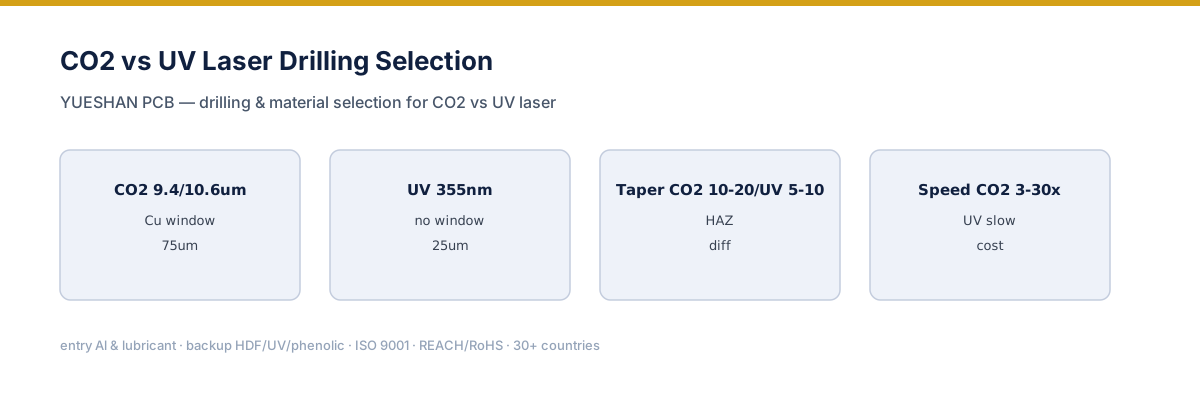
CO2 vs UV laser selection matrix diagram
Absorption, aperture, speed and cost split.
Laser">CO2

CO2 Laser

copper-window via

CO2 →
Laser">UV

UV Microvia

copper-direct via

UV →
Process">HDI

HDI & IC

build-up vias

HDI →
Pillar">Drilling

Mastering PCB Drilling

mechanical vs laser

pillar →
← Back to Blog Request Free Samples →

Frequently Asked Questions

YUESHAN supplies the flat HDI stacks used for both CO2 and UV laser drilling. The questions below cover the selection matrix.

CO2 or UV for HDI vias?

CO2 (9.4/10.6 um) needs a copper window, reaches about 75 um, 10-20 percent taper, cheaper equipment; UV (355 nm) needs no window, about 25 um, 5-10 percent taper, 3-10x slower (atlaspcb, gopcba).

Which laser gives the finer vias?

UV — down to about 25 um with near-cylindrical walls, versus CO2's about 75 um minimum.

Which laser is cheaper per hole?

CO2 has lower equipment cost and higher throughput (500-3000 holes/s vs 100-500); UV costs more but goes finer.

Do you need a copper window for UV laser?

No — UV is absorbed by copper, so it burns the via directly without pre-etching a window.

Can you mix CO2 and UV laser drilling?

Most HDI stacks use both — CO2 for cost-sensitive blind vias, UV for the finest build-up vias.

Do you supply laser-drilling support?

YUESHAN supplies the entry and backup that keep HDI stacks flat for laser ablation; request a sample.

LX

Mr. Lucky Xu — Director, YUESHAN PCB — Director, YUESHAN PCB

15 years in PCB drilling consumables. Wrote and technically reviewed this page; where a number is stated, the page says how it was measured, and any third-party or industry reference (IPC, Rogers, ISO, FDA, PCD tooling, CO2/UV laser, jiepei, hilelectronic, linkut) is named inline rather than presented as a YUESHAN specification.

About the author · Editorial standards & review process · Request TDS / SDS or a sample