Written & reviewed by Mr. Lucky Xu, Director — YUESHAN PCB
Delamination Control · 2026-10-31 · 7 min read
Short answer: Delamination at the hole is driven by excess heat, a dull bit, too-high feed or too-high stack height. Control it with lower spindle speed, a sharp bit, controlled feed, IPC-DR-572 retract of 1.5-2x, and a CAF-resistant FR4 to stop wicking microcracks from becoming conductive-filament failures.
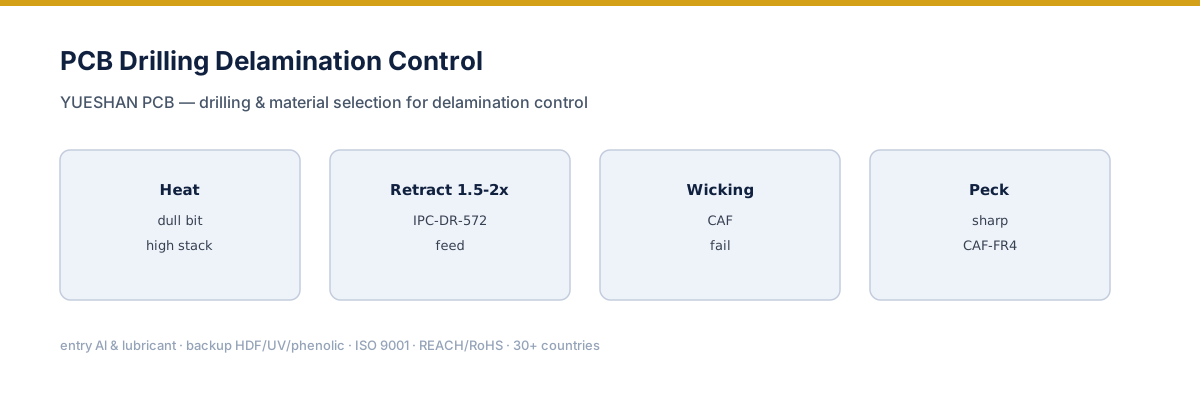
Number: Root causes are overheat, dull bit, high feed and high stack; the fix is lower RPM plus a sharp bit plus controlled feed, with IPC-DR-572 retract 1.5-2x of feed. Wicking (resin microcrack) can become a CAF (conductive anodic filament) failure in automotive, medical and communications boards, suppressed by a sharp bit, peck drilling and CAF-resistant FR4 (pcbsync, ipcb, anycba).
Boundary: The entry/backup board affects heat and support but does not own delamination; the drill program and laminate choice do. Treat delamination as a system issue, not a single material swap.
YUESHAN backup board supporting a stack to control heat and exit at drilling.
A delamination at the hole wall is a warning that the drilling system is out of balance — too much heat, a tired bit, or a stack that is asking for trouble. It rarely has a single cause.
Root causes
Heat from high RPM or a dull bit softens the resin.
Dull bit rubs instead of cutting, raising temperature and stress.
High feed forces the laminate faster than it can release.
High stack compounds heat and exit stress.
Control chain
Lever
Action
Reference
Spindle
Lower RPM, keep bit sharp
system control
Feed
Control feed, use peck (retract 1.5-2x)
IPC-DR-572
Stack
Reduce panels per stack
heat control
Laminate
Use CAF-resistant FR4
wicking suppression
A flat, stable backup board reduces exit stress and supports the panel, but it is one lever in a system. Pair it with a sharp bit and peck routine. See the resin smear page and the FR4 parameters page.
YUESHAN supplies the flat, rigid backup that supports the stack and limits exit stress. The questions below cover delamination root causes and the IPC-DR-572 retract rule.
What causes delamination during PCB drilling?
Overheat, a dull bit, high feed and high stack height — rarely one variable alone (pcbsync, ipcb, anycba).
How do you stop drilling delamination?
Lower the spindle RPM, keep the bit sharp, control feed, use the IPC-DR-572 retract of 1.5-2x, and reduce stack height.
What is wicking and why is it dangerous?
Wicking is a resin microcrack that can become a CAF (conductive anodic filament) failure in automotive, medical and communications boards; suppress it with a sharp bit, peck drilling and CAF-resistant FR4.
Does the backup board prevent delamination?
It reduces exit stress and supports the panel, but delamination is a system issue — tool, parameters and laminate own most of it.
How is delamination linked to resin smear?
Both trace to heat and tool condition; controlling one usually helps the other. See the resin-smear prevention page.
Do you supply delamination-control materials?
YUESHAN supplies HDF and phenolic backup that support the stack and limit exit stress; request a sample to qualify.
15 years in PCB drilling consumables. Wrote and technically reviewed this page; where a number is stated, the page says how it was measured, and any third-party or industry reference (IPC, Rogers, ISO, FDA, PCD tooling, CO2/UV laser, jiepei, hilelectronic, linkut) is named inline rather than presented as a YUESHAN specification.