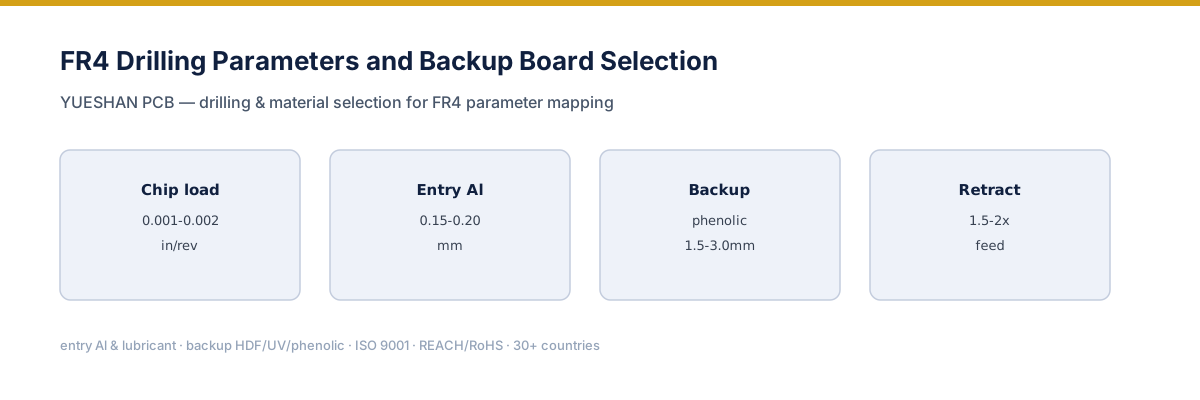
Short answer: Set FR4 drilling from IPC-DR-572 baselines (chip load 0.001-0.002 in/rev, retract 1.5-2x feed), pair a 0.15-0.20 mm aluminum entry with a 1.5-3.0 mm phenolic or HDF backup, then qualify on your actual stack. The board grade is chosen by the defect you are controlling, not by a price tag.
Number: IPC-DR-572 gives chip load 0.001-0.002 in/rev and retract 1.5-2x feed for FR-4; entry aluminum 0.15-0.20 mm and phenolic backup 1.5-3.0 mm are typical. An initial 40k RPM / 75 IPM suits 0.5-1.0 mm drills on 1.6 mm boards, high-Tg laminates drop feed about 20%, and hole-wall roughness target is Ra <=25 um (IPC-DR-572, jc-pcba).
Boundary: The entry and backup board only control entry stability and exit/burr condition; the drill program (RPM, feed, retract, peck) and machine condition own the rest. Qualify the material set against your real laminate and stack, not a generic table.

FR4 is still the default PCB substrate, but standard FR4, high-Tg FR4 and filled FR4 do not drill the same. The entry and backup board under the panel are what hold the laminate at entry and breakthrough, so the grade and thickness have to be matched to the hole size, stack and laminate — not copied from a price list.
Start from the IPC-DR-572 baselines
The IPC-DR-572 drilling recommendation is the reference most fabricators qualify against:
| Parameter | Typical FR-4 value | Why it matters |
|---|---|---|
| Chip load | 0.001-0.002 in/rev | Balances cutting load, heat and bit life |
| Retract (peck) | 1.5-2x feed rate | Evacuates chips, controls heat and delamination |
| Entry sheet | Aluminum 0.15-0.20 mm | Stabilizes the bit at entry, reduces wander and entry burr |
| Backup board | Phenolic 1.5-3.0 mm (or HDF) | Supports the panel at breakthrough, controls exit burr |
A starting point of 40k RPM / 75 IPM works for 0.5-1.0 mm drills on 1.6 mm boards; high-Tg laminates typically need about 20% lower feed because the resin is harder and generates more heat (jc-pcba).
Map the parameter to the board grade
| If you see... | Move to... | Proof to gather |
|---|---|---|
| Entry burr / wander on small holes | Thinner, flatter 1100 H18 entry (0.15 mm) or lubricant-coated entry | Entry burr count, hole position |
| Exit burr / breakout | Phenolic or dense HDF backup, correct thickness vs stack | Exit burr, breakout rate |
| Heat / smear rising with stack height | More aggress retract, flatter backup, lower stack | Smear test, bit temperature |
YUESHAN supplies 1100 H18 aluminum entry, lubricant-coated entry, HDF 840/880/950 and phenolic backup under ISO 9001, with TDS/MSDS, per-lot COA and REACH/RoHS declarations. Qualify the grade by the defect, then step up only where the data justifies it. See the entry board definition and the backup board definition.