Home / Blog / Resin Smear Prevention

Resin Smear Prevention in PCB Drilling

Resin Smear Prevention · 2026-10-31 · 7 min read

Short answer: Drilling heats the resin until it flows and coats the inner copper as a smear that blocks plating adhesion. Remove it with permanganate (swell-oxidize-neutralize, taking 0.02-0.05 mm of resin) for standard boards, or plasma (CF4/O2) when you need to reach recesses, treat glass, or process PTFE. Critically, permanganate does not etch PTFE — that needs plasma or sodium-naphthalene.

Number: Smear is molten resin film on inner copper after drilling; permanganate desmear (swell-oxidize-neutralize) removes about 0.02-0.05 mm of resin, plasma (CF4/O2) reaches recesses and treats glass fiber for high-reliability, thick or PTFE boards, and a backlight (shadow) test is run per lot. On PTFE, permanganate is ineffective, so plasma or sodium-naphthalene is required (gopcba, season-pcb, superb-tech, hilelectronic).

Boundary: Smear removal is a post-drill process; the entry/backup board influences heat and smear formation but does not replace desmear. The laminate type decides which desmear chemistry is valid.

PCB drilling resin smear prevention permanganate vs plasma PTFE desmear — YUESHAN
YUESHAN QC inspecting a drilled hole wall for resin smear before desmear.

Resin smear is one of the most common reasons a plated-through hole fails adhesion. It is not a drilling defect you can see from the top — it is a thin resin film left on the inner copper wall.

Why smear forms

The drill's friction heats the resin until it melts and smears across the exposed inner copper at the hole wall. If left, the electroless copper cannot bond and the via is unreliable.

Two removal routes

MethodHowWhen
PermanganateSwell-oxidize-neutralize; removes ~0.02-0.05 mm resinStandard FR4/HDI, most volumes
Plasma (CF4/O2)Reaches recesses, treats glass fiberHigh-reliability, thick, PTFE boards

The entry and backup board influence how much heat builds at the wall, so a stable, low-friction stack helps limit smear in the first place. See the entry board definition and the delamination control page.
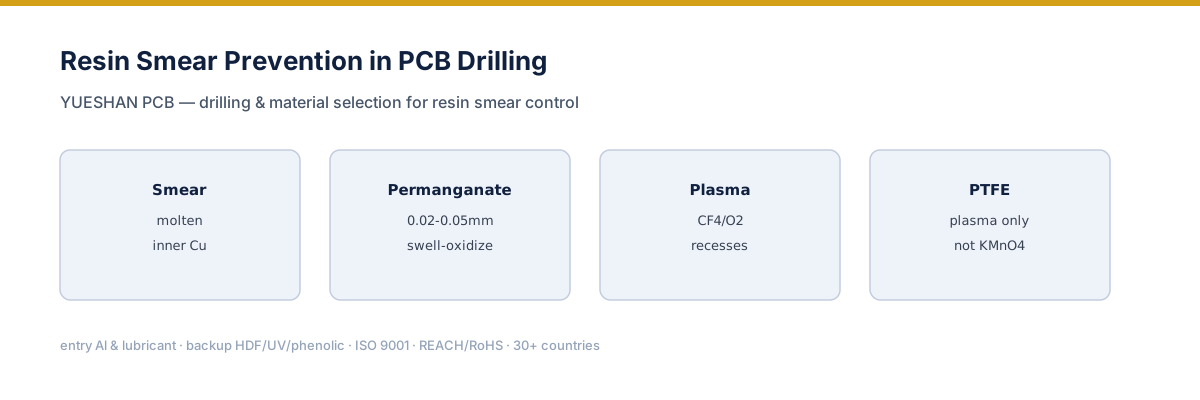
Resin smear prevention diagram
Smear formation and the two removal routes.
Entry">Lubricant

Lubricant Aluminum

lower friction, less heat

lubricant →
Backup">HDF

HDF Backup

flat, stable support

HDF →
PTFE">Plasma

Rogers/PTFE

desmear route

PTFE →
Pillar">Drilling

Mastering PCB Drilling

process + material map

pillar →
← Back to Blog Request Free Samples →

Frequently Asked Questions

YUESHAN supplies the stable entry and backup that limit heat and smear at the hole wall. The questions below cover what smear is and permanganate versus plasma removal.

What is resin smear in PCB drilling?

Drilling heat melts the resin so it coats the inner copper wall, blocking plating adhesion if left in place (gopcba, season-pcb, superb-tech).

How do you remove resin smear after drilling?

Permanganate (swell-oxidize-neutralize) removes about 0.02-0.05 mm of resin for standard boards; plasma (CF4/O2) reaches recesses and treats glass fiber for high-reliability, thick or PTFE boards.

Does permanganate work on PTFE smear?

No — permanganate does not etch PTFE, so use plasma or sodium-naphthalene treatment (hilelectronic, xcepcb).

How do you verify smear is gone?

A backlight (shadow) test is run per lot to confirm the inner wall is clean before plating.

Does the backup board affect smear formation?

A stable, low-friction stack — lubricant entry and a flat backup — limits heat at the wall and reduces smear formation, but desmear is still required post-drill.

Do you supply smear-control materials?

YUESHAN supplies lubricant-coated entry and HDF/phenolic backup that help control drilling heat; request TDS and a sample.

LX

Mr. Lucky Xu — Director, YUESHAN PCB — Director, YUESHAN PCB

15 years in PCB drilling consumables. Wrote and technically reviewed this page; where a number is stated, the page says how it was measured, and any third-party or industry reference (IPC, Rogers, ISO, FDA, PCD tooling, CO2/UV laser, jiepei, hilelectronic, linkut) is named inline rather than presented as a YUESHAN specification.

About the author · Editorial standards & review process · Request TDS / SDS or a sample