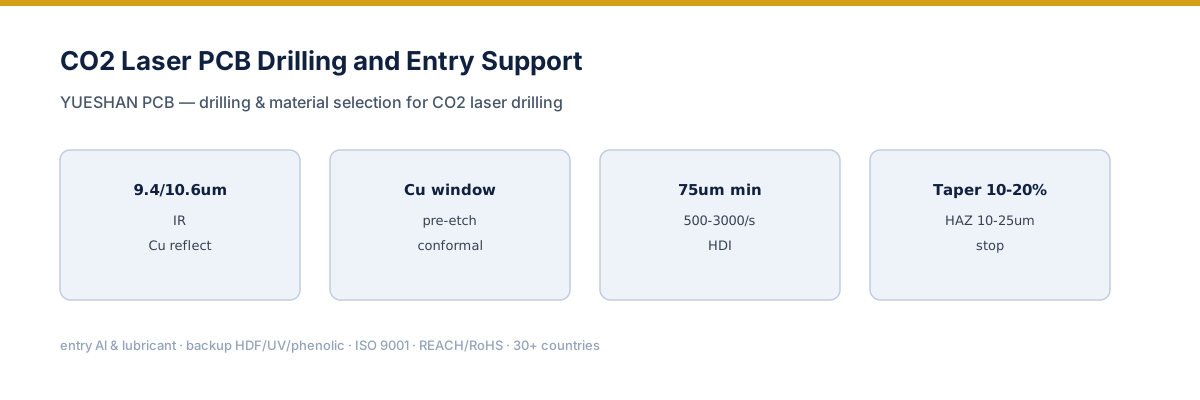
Short answer: CO2 lasers (9.4/10.6 um infrared) are absorbed by the organic dielectric but reflected by copper, so you either pre-etch a copper window or use a conformal mask; the underlying copper acts as a natural stop for blind vias. Use CO2 for HDI blind vias down to about 75 um at 500-3000 holes/s, and keep mechanical drilling for larger through-holes.
Number: CO2 lasers run at 9.4 or 10.6 um; because copper reflects IR, the process needs a pre-etched copper window or conformal mask, with the copper plane as a natural stop. Typical output is 500-3000 holes/s, minimum about 75 um, taper 10-20 percent and HAZ 10-25 um; equipment cost is lower than UV laser (atlaspcb, fastturnpcbs).
Boundary: A laser drills the dielectric; the entry/backup board question barely applies to pure laser ablation, but the copper window definition and stack flatness still matter. Laser and mechanical are complementary, not competing — most HDI stacks use both.

CO2 laser drilling is the workhorse for HDI blind vias: fast, mature and cheap relative to UV. But it only removes the organic dielectric — copper bounces the beam back — so the process is really about where you let the laser land.
Why copper needs a window
The 9.4/10.6 um CO2 wavelength is absorbed by the resin/glass dielectric but reflected by copper. That is both a limitation and a feature:
- Limitation: you must expose the dielectric — either by pre-etching a copper window or applying a conformal mask.
- Feature: the copper plane underneath acts as a natural stop, so the blind via depth self-limits at the next copper layer.
CO2 envelope
| Metric | Typical |
|---|---|
| Wavelength | 9.4 / 10.6 um (IR) |
| Throughput | 500-3000 holes/s |
| Minimum aperture | about 75 um |
| Taper | 10-20 percent |
| HAZ | 10-25 um |
| Equipment cost | Lower than UV laser |
Where the material set still matters: a flat, clean stack and well-defined copper window keep the via centered and the stop reliable. For finer, copper-direct features see the UV laser microvia page and the CO2 vs UV selection matrix.