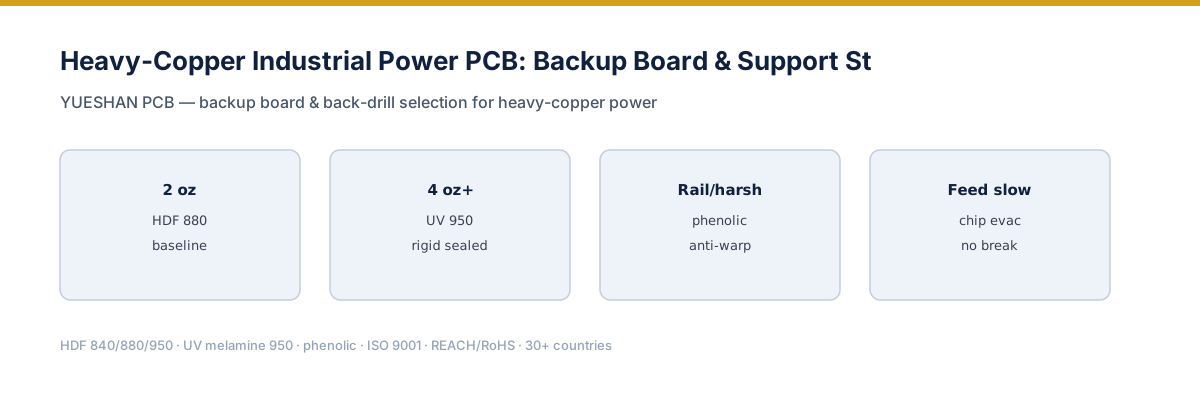
Short answer: Industrial power PCBs carry 2 oz to 6 oz (70 to 210 micron) copper that raises cutting force and heat. Use a rigid, flat backup (HDF 880, UV melamine 950 or phenolic) that supports the exit, slow feed and improve chip evacuation to avoid bit breakage, and qualify the grade on the actual thick-copper stack.
Number: Heavy copper starts at 2 oz (70 micron) and reaches 4 to 6 oz for inverters, UPS, DC-DC and rail power converters; drilling through thick copper needs slower feed rates and proper chip evacuation to avoid drill-bit breakage and rough hole walls (Oneseine).
Boundary: The backup board manages exit and location at the bottom of the stack; the entry sheet and drill program manage the top. Grade-match per product family, not plant-wide. See the backup board definition and the heavy-copper entry guide.

Industrial power electronics — switch-mode supplies, UPS, inverters, DC-DC converters and rail power modules — push copper weight up to carry current and spread heat. That same thick copper is what raises drilling force and bit temperature on every hole, and the backup board under the panel is what keeps the exit clean.
Why heavy copper changes the support problem
- More cutting force: thicker copper resists the bit, raising torque and heat at the tip.
- Bit breakage risk: drills driven too fast into thick copper snap at breakthrough; slower feed plus deeper peck is the standard mitigation.
- Exit tear-out: a soft or worn backup lets the bottom copper tear into a burr, so rigidity and flatness matter more than on a 1 oz board.
Backup choice for power PCB
| Copper weight | Recommended backup | Why |
|---|---|---|
| 2 oz (70 micron) | HDF 840 / 880 | economical flat baseline |
| 4 oz+ (140 micron) | UV melamine 950 or phenolic | rigid, sealed, anti-warp at exit |
| Rail / harsh environment | phenolic or sealed UV | dimensional stability under cycling |
| Any, heavily drilled | replace before worn | a board full of old holes no longer supports evenly |
Feed and drilling adjustment
On thick copper, slow the feed, deepen peck to clear chips from the thicker metal, and qualify the bit-life interval on the actual stack rather than a supplier default. Oneseine notes that drilling through thick copper requires slower feed rates and proper chip evacuation to avoid drill-bit breakage and rough hole walls — the backup board only does its job if the stack is supported flat and the bits are not overloaded.
Applications and build note
Heavy-copper power boards span SMPS, UPS, DC-DC, inverters, BMS, chargers and railway power converters (Hisupplier lists power converters for railway systems). Note that not every power supply needs high-Tg: some 4 oz supplies are built on Tg 135 C FR4 to IPC-6012 Class 2, so specify the laminate to the thermal load rather than assuming automotive-grade Tg. For the matching entry side see the heavy-copper entry board guide and the backup board definition.