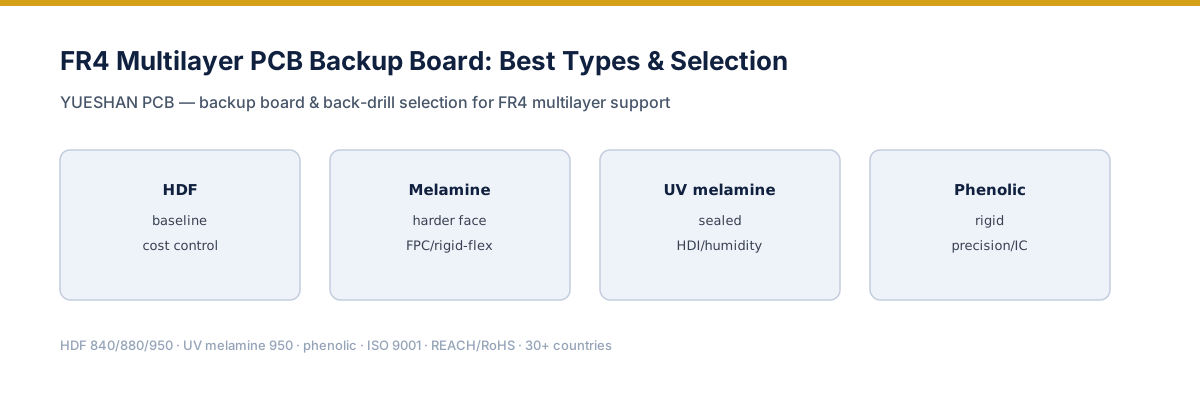
Short answer: For FR4 multilayer PCB drilling, start with HDF as the general baseline, move to melamine or UV melamine when a harder or moisture-sealed surface helps, and reserve phenolic for precision work that can prove a need. Choose by smallest drill, construction, stack height, storage humidity and the defect you are controlling, not by a premium-versus-cheap label.
Number: HDF, melamine-laminated, UV melamine and phenolic are the four support families; the winning grade is the one that meets output targets at the best total cost per good panel, so qualify by defect rather than by sticker price (YUESHAN choose-backup-board guide).
Boundary: The backup board is half the drilling-quality equation; the entry board and drill program are the other half. Pair the grade with the entry sheet and qualify on your actual stack. See the backup board definition and the how-to-choose guide.

Multilayer FR4 boards have been the default PCB substrate for decades, but every extra layer adds drilling load, heat at the bit and sensitivity to support-plane stability. The backup board under the panel is what holds the laminate at breakthrough, so the grade has to be matched to the build — not guessed from a price list.
Why multilayer FR4 changes the backup choice
More layers mean more resin and glass between the bit and the exit, more heat, and a thinner margin for location error. A qualification-first path beats a brand-name habit:
- Smallest mechanical hole: smaller holes amplify sensitivity to entry, drill condition, support and stack stability — record the real production distribution, not just the drawing minimum.
- PCB construction: layer count, thickness, laminate family and heavy copper (where present) change drilling load and heat.
- Stack height: panels per stack change throughput and drill load; never compare backup boards at different stack counts.
- Humidity and storage: a fibre board that warps after opening the package can become the real cause of hole drift or breakthrough instability.
- Named defect: exit burr, snapping, smear, hole location, drill life and warpage each point to a different corrective action.
The four support families
| Family | Material identity | When to evaluate | Reason |
|---|---|---|---|
| HDF | Dense wood-fibre panel | Stable standard multilayer, cost pressure | Economical, broad standard use, flat support |
| Melamine-laminated | HDF core + hot-pressed melamine surface | Harder fused face, FPC, rigid-flex | Surface integrity + resilient core |
| UV melamine | HDF core + UV-cured sealed surface | Humidity, HDI, low-smear, tighter stack | Moisture sealing, surface stability |
| Phenolic | Phenolic resin + paper/fibre laminate | Selected precision, IC, routing | High rigidity and dimensional stability |
Decision matrix by condition
| Condition | Starting family | Proof to gather during qualification |
|---|---|---|
| Stable standard multilayer, cost pressure | HDF | Flatness, burr, bit life, lot consistency |
| Need harder fused face / FPC / rigid-flex | Melamine laminate | Surface condition, burr, tool wear, moisture |
| Humidity / HDI / low-smear / tighter stack | UV melamine | Post-storage flatness, hole wall, burr, yield |
| Selected precision / IC / routing | Phenolic | Quality gain versus bit wear and total cost |
Where YUESHAN fits
YUESHAN supplies HDF 840 / 880 / 950, UV melamine 950 and phenolic backup boards under ISO 9001, with full TDS/MSDS, a per-lot COA and REACH/RoHS declarations, to fabricators in 30+ countries. The practical move is to start from HDF on a standard multilayer line, prove the defect you are actually fighting, then step up to a sealed UV-melamine or phenolic grade only where the data justifies it. See the how-to-choose guide and the materials reference for the full family map.