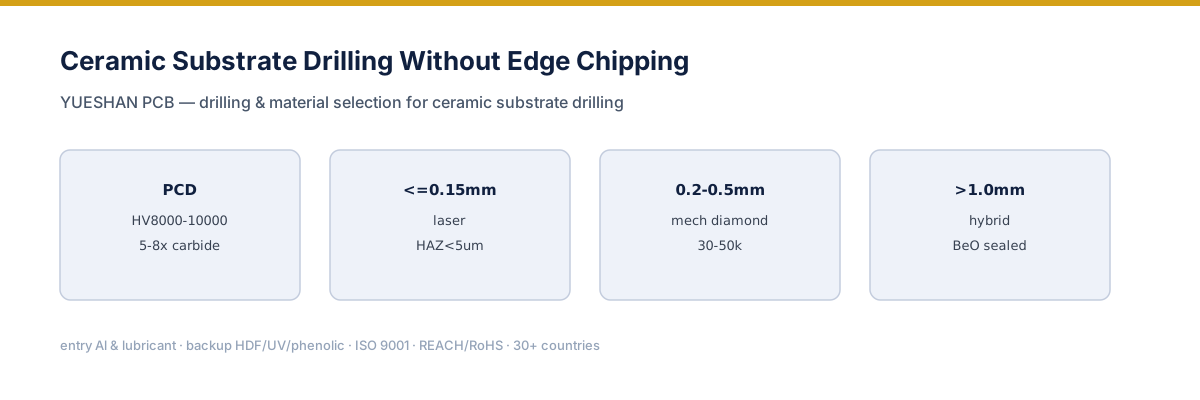
Short answer: Ceramic substrates (AlN, Al2O3, SiC, ZrO2) are brittle, so chipping is a tool-and-energy problem: use diamond-coated or PCD tooling, and pick the process by hole size — laser at or below 0.15 mm, mechanical diamond-coated 0.2-0.5 mm, hybrid above 1.0 mm. Beryllia (BeO) dust is toxic and must be handled in sealed laser equipment.
Number: Polycrystalline diamond (PCD) runs at HV 8000-10000, about 5-8x the hardness of carbide, and alumina-grade tools last over 50x a carbide tool (linkuttools, tshztech). Industry chipping rates can reach 30 percent with the wrong setup but exceed 95 percent with high-speed, closed-loop control at about plus/minus 0.02 mm (engelcnc). Aperture rule of thumb: <=0.15 mm laser (10-20 ns, 50-100 kHz, HAZ <5 um), 0.2-0.5 mm mechanical diamond-coated (118-degree edge, 30k-50k rpm, 50-100 mm/min, air cooled), >1.0 mm laser plus mechanical hybrid (ipcb).
Boundary: The material set (entry/backup) only stabilizes the workpiece; the drill tool (diamond/PCD) and process own chipping control. Beryllia (BeO) is toxic — we describe sealed laser handling, not encourage mechanical machining of BeO.

Ceramic substrates (AlN, Al2O3, SiC, ZrO2) are used where FR4 cannot go — high thermal conductivity, low loss, dimensional stability. But they are brittle, and edge chipping at the hole is the failure mode that decides yield.
Tooling is non-negotiable: diamond or PCD
| Tool | Property | When |
|---|---|---|
| PCD (polycrystalline diamond) | HV 8000-10000, 5-8x carbide hardness | Production ceramic drilling, longest life |
| Diamond-coated microdrill | CVD diamond on carbide | Fine holes, M9 ceramic-filled boards |
| Alumina-grade tool | Life >50x carbide | Selected ceramic grades |
Split the process by hole size
- <=0.15 mm: laser (pulse 10-20 ns, 50-100 kHz, HAZ <5 um) to avoid mechanical stress.
- 0.2-0.5 mm: mechanical diamond-coated drill, 118-degree edge, 30k-50k rpm, 50-100 mm/min, air cooled.
- >1.0 mm: laser plus mechanical hybrid for throughput and edge quality.
- BeO (beryllia): toxic dust — handle only in sealed laser equipment; do not mechanically machine it openly (ipcb).
YUESHAN supplies the stable aluminum entry and rigid backup used to hold ceramic substrates flat during drilling; the diamond/PCD tool and process own chipping control. See the ceramic drill-bit selection and bit-life ceramic vs FR4 pages for tool detail.