Home / Blog / Ceramic Drill Bit Selection

Ceramic Drill Bit Selection (PCD vs CVD Diamond)

Ceramic Drill Selection · 2026-10-31 · 7 min read

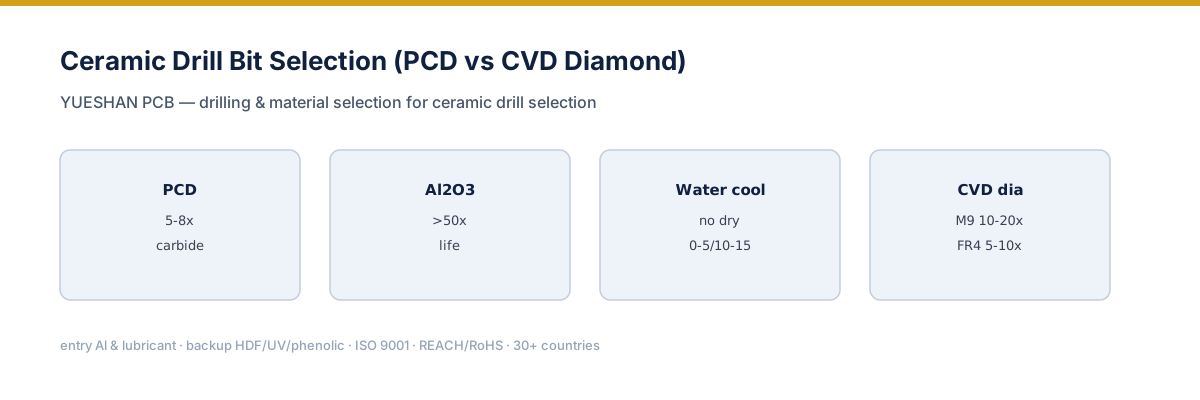
Short answer: For ceramic and ceramic-filled boards, pick PCD or CVD-diamond tooling: PCD is 5-8x carbide hardness and alumina-grade tools last over 50x a carbide bit; run PCD on 3k-8k rpm with water-based coolant (never dry cut) at rake 0-5 deg and clearance 10-15 deg. CVD-diamond-coated microdrills reach 5-10x FR4 life on standard ceramic-filled and 10-20x on M9 grades.

Number: PCD hardness is 5-8x carbide; alumina-grade tool life exceeds 50x carbide. PCD runs at 3k-8k rpm with water-based coolant (dry cutting is prohibited), rake 0-5 deg and clearance 10-15 deg (linkuttools). PCB ceramic-filled M9 uses CVD diamond-coated microdrills at 5-10x FR4 life, 10-20x on M9; nano-ceramic AlN CCL drill life is only 32-41 percent of a PTFE board (tshztech, gopcba).

Boundary: The tool owns life and chipping; the entry/backup board stabilizes the brittle substrate. Select the bit by the ceramic grade and the laminate maker's guidance, not a generic table.

Ceramic drill bit selection PCD CVD diamond coated alumina coolant — YUESHAN
CVD diamond-coated and PCD drill bits for ceramic substrate drilling.

Drilling ceramic and ceramic-filled laminates is a tooling decision first. A standard carbide bit either wears out in hundreds of hits or chips the edge; the answer is diamond in one of two forms.

PCD vs CVD diamond

ToolHardness / lifeUse
PCD5-8x carbide hardnessProduction runs, rigid setups
Alumina-grade>50x carbide lifeSelected ceramic grades
CVD diamond-coated microdrill5-10x FR4 life, 10-20x on M9Fine ceramic-filled holes

Operating rules

Pair the tool with a rigid, flat backup so the brittle substrate does not flex. See the no-chipping page and bit-life comparison.
Ceramic drill bit selection diagram
Tool hardness, coolant and angle rules.
Substrate">No-chip

Ceramic No-Chip

process split

no-chip →
Life">Compare

Bit Life Ceramic vs FR4

quantified

life →
Backup">Phenolic

Phenolic Backup

rigid support

phenolic →
Pillar">Drilling

Mastering PCB Drilling

process + material map

pillar →
← Back to Blog Request Free Samples →

Frequently Asked Questions

YUESHAN supplies the rigid backup that holds brittle ceramic substrates flat during drilling. The questions below cover PCD versus CVD diamond, coolant and angles.

PCD or CVD diamond for ceramic drilling?

PCD is 5-8x carbide hardness; CVD diamond-coated microdrills run 5-10x FR4 life on standard ceramic-filled and 10-20x on M9 grades (tshztech, linkuttools).

How long do ceramic drill bits last?

Alumina-grade tools exceed 50x carbide life; on M9 ceramic-filled, CVD diamond reaches 10-20x FR4 life (tshztech).

Can you dry-cut ceramic with PCD?

No — PCD requires water-based coolant; dry cutting is prohibited because heat cracks the ceramic (linkuttools).

What angles for ceramic drilling?

Rake 0-5 degrees, clearance 10-15 degrees, with PCD running at 3k-8k RPM (linkuttools).

Is nano-ceramic AlN CCL hard on drills?

Yes — nano-ceramic AlN CCL drill life is only 32-41 percent of a PTFE board, so qualify the tool before volume (gopcba).

Do you supply ceramic drilling backup?

YUESHAN supplies phenolic/HDF backup that holds ceramic substrates rigid; the diamond/PCD tool is selected by the fabricator. Request a sample.

LX

Mr. Lucky Xu — Director, YUESHAN PCB — Director, YUESHAN PCB

15 years in PCB drilling consumables. Wrote and technically reviewed this page; where a number is stated, the page says how it was measured, and any third-party or industry reference (IPC, Rogers, ISO, FDA, PCD tooling, CO2/UV laser, jiepei, hilelectronic, linkut) is named inline rather than presented as a YUESHAN specification.

About the author · Editorial standards & review process · Request TDS / SDS or a sample