Home / Blog / Automotive Backup Board

Automotive PCB Backup Board Selection: Temperature Grades & Standards

Backup Board Guide · 2026-10-31 · 7 min read

Short answer: Automotive PCBs run from minus 40 to plus 150 degrees C by grade and must survive 15-plus years, so the backup board is selected to the temperature class and layer profile. Use HDF or UV melamine for most stacks and phenolic where rigidity is proven; materials carry IATF 16949, high-Tg at or above 170 degrees C and CAF resistance, with the grade set locked per lot.

Number: AEC-Q100 Grade 0 minus 40 to plus 150 C (engine bay), Grade 1 minus 40 to plus 125 C, Grade 2 minus 40 to plus 105 C (cabin), Grade 3 minus 40 to plus 85 C (infotainment); IPC-6012 Class 3 with the IPC-6012DA automotive addendum, and IATF 16949 with APQP, PPAP, FMEA and SPC discipline (JLCPCB, AtlasPCB, Andwin).

Boundary: The backup board is one layer of a qualified automotive stack; pair it with the correct entry and drill program and keep grade-locking so the set never drifts. See the automotive drilling hub and the backup board definition.

Automotive PCB backup board temperature grades IATF 16949 — YUESHAN
YUESHAN HDF and UV melamine backup boards for automotive-grade PCB drilling.

Automotive electronics must be reliable for 15-plus years across minus 40 to plus 150 degrees C and survive vibration and humidity — a bar far above consumer grades. The backup board is selected to that temperature class and the board layer profile, not by habit.

Automotive temperature grades

GradeRangeUseBackup default
Grade 0-40 to +150 Cengine bayrigid sealed, phenolic where proven
Grade 1-40 to +125 Cengine bay, exteriorUV melamine 950
Grade 2-40 to +105 Cpassenger cabinHDF 880/950
Grade 3-40 to +85 Cinfotainment, bodyHDF 840/880

Standards the program expects

Car-grade boards are built to a stacked set of requirements: IATF 16949:2016 (the automotive quality-management system built on ISO 9001:2015, adding APQP, PPAP, FMEA and SPC), IPC-6012 Class 3 with the IPC-6012DA automotive addendum, AEC-Q100/101/200 for components, ISO 26262 for functional safety, substrate minimum Tg 170 C, CAF resistance and UL 94 V-0. YUESHAN supplies the entry and backup consumables against that same quality system, with REACH/RoHS declarations and per-lot traceability.

Backup board role in automotive stacks

Because automotive acceptance targets sub-1 DPPM on safety-critical boards, the qualified grade set is grade-locked: alloy, thickness and resin stay fixed, and a revised datasheet revision is required for any tolerance move. YUESHAN offers grade locking and per-lot COA for qualified automotive programs. See the automotive drilling hub and the backup board definition for the matched material map.
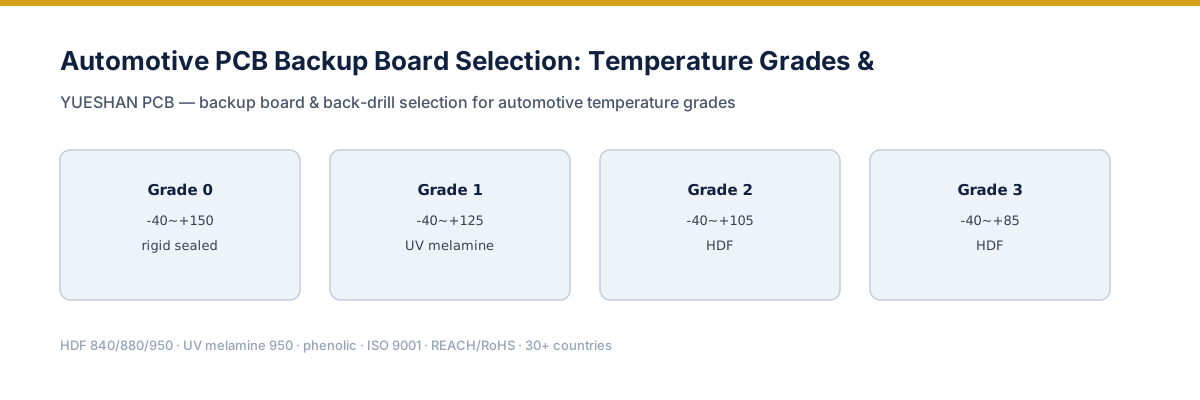
Automotive backup board grade selection diagram
Temperature grade to the backup board spec for automotive PCB drilling.
Material">HDF

HDF Backup Board

840/880/950 automotive baseline

HDF →
Material">Sealed

UV Melamine Backup

Grade 950 for humidity/HDI

UV melamine →
Hub">Automotive

Automotive PCB Drilling

matched backup + entry

automotive hub →
Resource">Backup

What Is a Backup Board

HDF / melamine / phenolic

backup →
← Back to Blog Request Free Samples →

Frequently Asked Questions

YUESHAN supplies HDF, UV melamine and phenolic backup boards referenced to IATF 16949 / IPC-6012 Class 3 automotive practice. The questions below cover temperature grades, standards and backup-board selection for automotive PCBs.

What temperature grades apply to automotive PCBs and how do they affect the backup board?

AEC-Q100 defines Grade 0 (-40 to +150 C, engine bay), Grade 1 (-40 to +125 C), Grade 2 (-40 to +105 C, cabin) and Grade 3 (-40 to +85 C, infotainment) (JLCPCB, AtlasPCB, Andwin). The backup board is one layer of the qualified automotive stack and must hold location across those cycles, so grade-lock the alloy, thickness and coating.

Which standards govern automotive PCB drilling materials?

IATF 16949:2016 (built on ISO 9001:2015 with APQP, PPAP, FMEA and SPC), IPC-6012 Class 3 with the IPC-6012DA automotive addendum, and AEC-Q100/101/200 for components; ISO 26262 covers functional safety (AtlasPCB, pcbark, Andwin). YUESHAN references these in its automotive documentation.

What backup board thickness and grade for automotive PCBs?

HDF 840/880/950 is the baseline for most automotive multilayer stacks; UV melamine 950 is stepped up for humidity-prone, HDI and ADAS lines; phenolic is reserved for precision or IC routing that can prove the rigidity gain. Grade-lock the set so the qualified stack never drifts.

Why is high-Tg (>=170 C) required in automotive PCBs?

Automotive substrates require minimum Tg 170 C, low Z-axis CTE to avoid via-barrel cracking on thermal cycling, and CAF resistance; the backup board supports clean drilling of these filled, rigid laminates without adding heat or smear (AtlasPCB).

How does the backup board affect automotive reliability targets?

Clean hole walls and stable location reduce plating voids and annular-ring loss that drive field failures; automotive acceptance targets sub-1 DPPM for safety-critical boards. A qualified, grade-locked backup material is part of that control plan, alongside the backup and drill program.

Do you supply automotive-grade backup boards?

YUESHAN supplies HDF, UV melamine and phenolic backup boards referenced to IATF 16949 / IPC-6012 Class 3 automotive practice, with TDS, per-lot COA and grade-locking; request a sample to trial on your ADAS or power-electronics stack.

LX

Mr. Lucky Xu — Director, YUESHAN PCB — Director, YUESHAN PCB

15 years in PCB drilling consumables. Wrote and technically reviewed this page; where a number is stated, the page says how it was measured, and any third-party or industry reference (IEC, IPC, MIL-STD, EN 45545, AEC-Q100, HilPCB, JLCPCB, Camptech II) is named inline rather than presented as a YUESHAN specification.

About the author · Editorial standards & review process · Request TDS / SDS or a sample