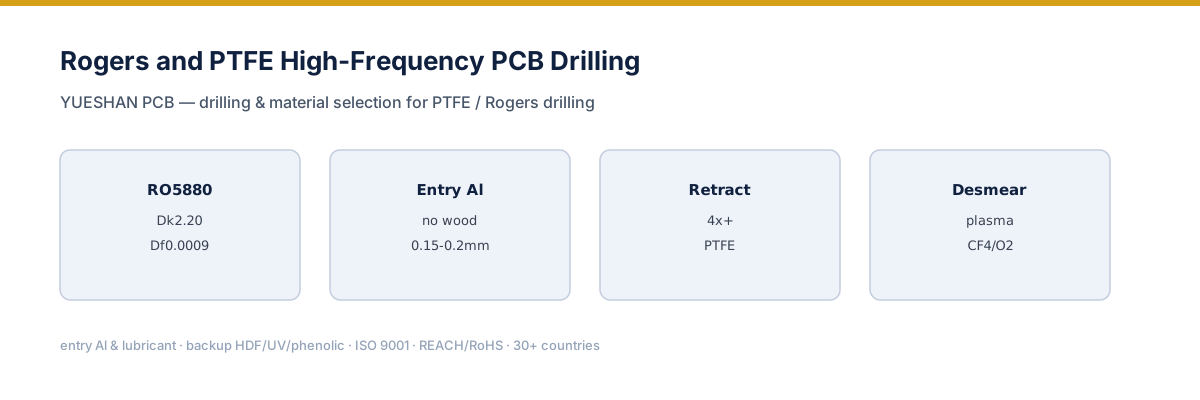
Short answer: PTFE and Rogers materials are soft and resin-rich, so use a clean aluminum entry (never a moisture-absorbing wood-composite), raise the retract to 4x or more, keep stack to 1-2 sheets, and remove smear with plasma or sodium-naphthalene — permanganate does not etch PTFE. Choose the grade by Dk/Df and the via you need.
Number: Rogers RO5880 is Dk 2.20 / Df 0.0009, RO3003G2 uses a 130-degree point, chip load 0.05-0.08 mm/rev and surface speed 150-200 SFM, and RO4000 is ceramic-filled. PTFE chip load is about 0.0015-0.0025 in/rev with retract 4x or higher. Because permanganate does not attack PTFE, desmear is done by plasma (CF4/O2, 200-400 W, 5-10 min) or sodium-naphthalene (RO5880/RO3003G2 datasheets, hilelectronic, 8pcba, xcepcb).
Boundary: The material set (entry/backup) controls entry stability and exit condition; the drill program and laminate prep own smear removal and hole geometry. Any Dk/Df and drill recipe must follow the laminate maker's process guide, not a generic table.

PTFE and Rogers materials (RT/duroid, RO3000, RO4000 families) are prized for low Dk/Df but are soft, resin-rich and notoriously easy to smear or delaminate. They need a different material and process mindset than FR4.
Pick the laminate by the electrical target
| Material | Key property | Drilling note |
|---|---|---|
| RO5880 | Dk 2.20 / Df 0.0009 | Very soft; single or double sheet stack, clean Al entry |
| RO3003G2 | 130-degree point, 0.05-0.08 mm/rev, 150-200 SFM | Controlled chip load, stable entry |
| RO4000 (ceramic-filled) | Ceramic filler | Abrasiver; bit wears 2-3x faster than FR4 |
Run the stack and process differently from FR4
- Entry: aluminum 0.15-0.20 mm, never a wood-composite sheet — PTFE absorbs moisture from composite tooling and that shifts hole position.
- Retract: 4x or more of feed to clear the gummy resin and keep heat down.
- Stack: 1-2 sheets; PTFE smears badly when stacked deep.
- Smear removal: permanganate (the standard FR4 desmear) does not etch PTFE. Use plasma (CF4/O2, 200-400 W, 5-10 min) or sodium-naphthalene treatment (hilelectronic, xcepcb, uniwellcircuits).
YUESHAN supplies the aluminum entry and matched backup family (HDF, UV melamine, phenolic) used to hold PTFE/Rogers stacks stable during drilling; the laminate maker's drill and desmear recipe governs the final hole. See the entry board definition and the 5G and server drilling page for the high-frequency material path.