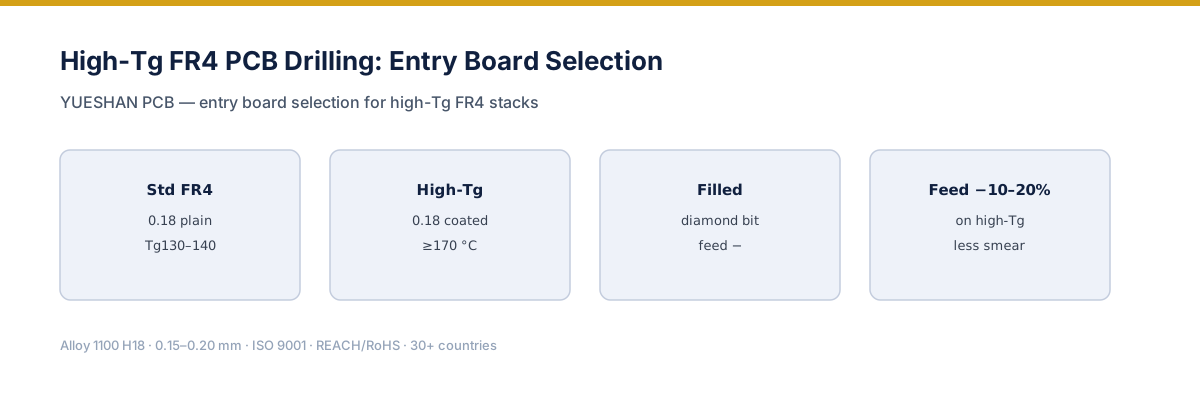
High-Tg FR4 (≥170 °C) has a harder, more brittle resin that wears drills faster and raises burr and rough-wall risk. Use a coated entry to cool and lubricate the tip, or a phenolic-clad / coated grade where wear is acute; keep 0.18 mm as the default and reduce feed 10–20%.
High-Tg resin cross-links more densely than standard FR-4 (Tg 130–140 °C), so it cuts with more resistance and melts onto the bit more readily — driving wall roughness above 20 µm and accelerating tool wear.
Entry and backup materials reduce heat at the source; they do not replace desmear chemistry. Adjust feed and speed to the laminate, and qualify the bit-life interval on the actual high-Tg stack. Entry board definition · thickness guide.

High-Tg FR4 — Tg ≥170 °C — is specified wherever the board sees heat: automotive, servers, LED, power. But the same cross-linked resin that gives thermal resistance makes the board harder to drill, and the difference shows up first at the entry surface.
Why high-Tg is harder to drill
- Harder, more brittle resin: higher cross-link density means more cutting resistance; the bit dulls faster and the wall roughens.
- More heat, more smear: the resin melts onto the bit more readily, spreading across the wall as smear that later has to be removed by desmear.
- Glass-fibre wear: the tight glass/resin bond blunts the edge quickly; industry guidance recommends bit changes as early as every 600–800 holes on high-Tg.
Entry board choice for high-Tg
| Laminate | Recommended entry | Note |
|---|---|---|
| Standard FR-4 (Tg 130–140 °C) | 0.18 mm plain 1100 H18 | default for 4–12 layer |
| High-Tg FR-4 (≥170 °C) | 0.18 mm coated, or phenolic-clad where wear is acute | coating cools and lubricates the tip |
| Filled resin (SiO₂, AlN) | coated entry + diamond-coated bit; reduce RPM | fillers accelerate wear sharply |
A coated entry board — thermoset (≈220 °C) or water-soluble — cools the bit and cuts smear, which is exactly where high-Tg hurts most. YUESHAN's coated grades run 30%+ longer bit life on HDI and high-Tg boards.
Parameter adjustment
On high-Tg stacks, industry guidance is to reduce feed rate 10–20% to minimise cracking and tool wear, lower RPM on filled resins, and deepen peck slightly to clear chips. Reduce entry and exit feed further to control burr. Always qualify the bit-life interval against wall quality on a sample of the actual laminate.
For hole-size-to-thickness matching see the entry board thickness guide and the reduce drill temperature guide.