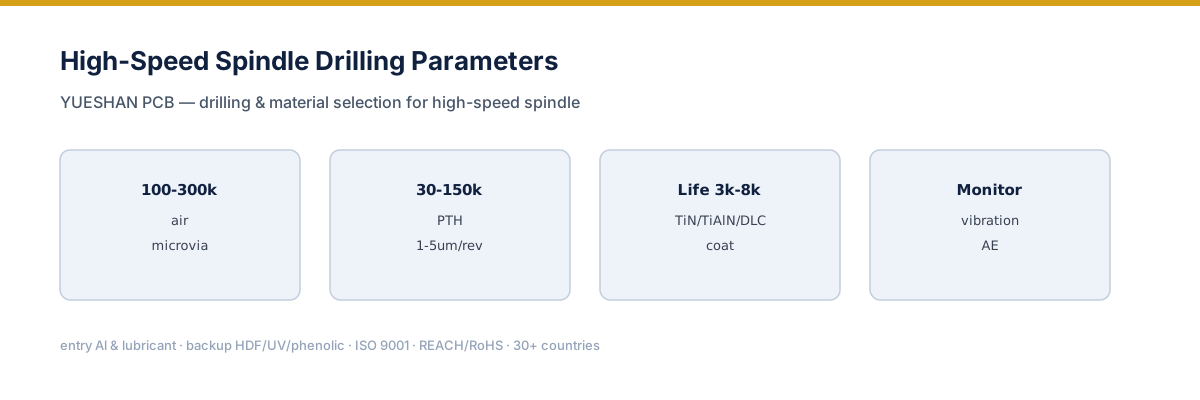
Short answer: Air-bearing spindles run 100k-300k RPM for microvias and 30k-150k RPM for PTH at chip loads of 1-5 um/rev. Standard bit life is 3k-8k hits (800-2k for microvia); coatings TiN (+3x), TiAlN (+5x) and low-friction DLC extend it, and vibration or acoustic-emission sensing catches wear before it ruins holes.
Number: Air-bearing spindles reach 100k-300k RPM for microvias and 30k-150k RPM for PTH, with feed 1-5 um/rev; an aluminum or composite entry prevents wander and entry burr. Bit life is about 3k-8k hits standard and 800-2k for microvia; coatings extend life TiN about +3x, TiAlN about +5x, DLC (low-friction, PTFE-like) further, with vibration/acoustic-emission monitoring of wear (andwinpcb, jiepei, inter-activesolutions, hooguu).
Boundary: The spindle and coating own speed and life; the entry/backup board stabilizes the panel and the reference surface. Tie spindle parameters to the actual bit and laminate, not a generic chart.

As holes shrink, the spindle — not the drill program alone — becomes the limiting factor. Air-bearing spindles let fabricators push into microvia territory, but only if the bit, coating and support are matched.
Speed bands by hole type
| Application | Spindle | Feed |
|---|---|---|
| Microvia | 100k-300k RPM (air-bearing) | 1-5 um/rev |
| PTH | 30k-150k RPM | 1-5 um/rev |
Life and coatings
- Standard life: about 3k-8k hits; microvia bits 800-2k hits.
- Coatings: TiN about +3x life, TiAlN about +5x, DLC (low-friction, PTFE-like) reduces sticking and heat.
- Monitoring: vibration or acoustic-emission sensors flag wear before it scatters holes.
A stable aluminum or composite entry keeps the bit locating on every hit, which protects both life and position. See the thick-copper feed guide and the drilling parameters guide.