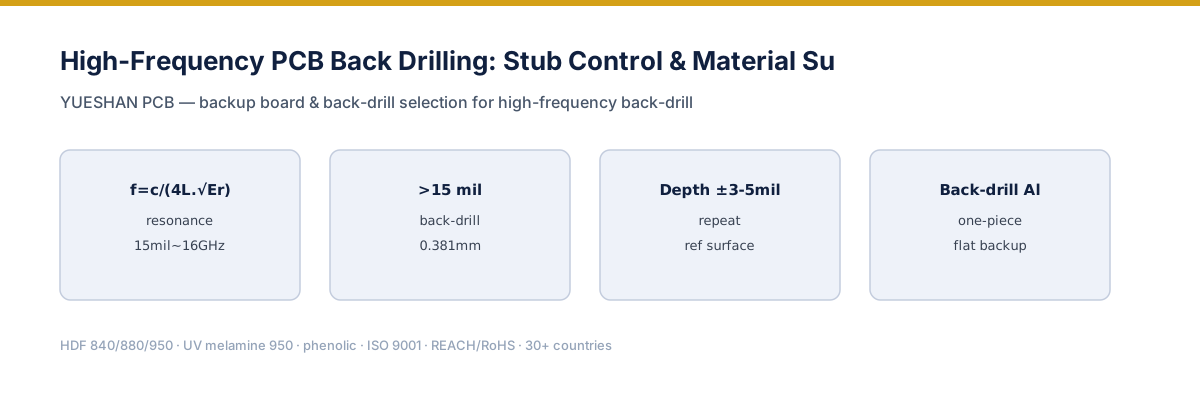
In high-frequency PCBs a residual via stub resonates at f approximately c divided by (4 times L times square root of Er). Any stub above about 15 mil (0.381 mm) should be back-drilled, with the finished stub held under 8 to 10 mil for above 15 GHz and depth controlled to plus or minus 3 to 5 mil. The entry or reference sheet and a flat, rigid backup are what keep that depth repeatable across the panel.
Quarter-wave resonant frequency f approximately c divided by (4 times L times square root of Er): a 15 mil stub on FR-4 (Er about 4.2) resonates near 16 GHz, a 10 mil stub near 24 GHz (Camptech II, JLCPCB, xcepcb). Industry practice back-drills stubs longer than 15 mil (0.381 mm), and back-drill depth tolerance is typically plus or minus 3 to 5 mil with the back-drill bit 0.1 to 0.25 mm larger than the original via (Camptech II, JLCPCB plus or minus 0.1 mm).
Back drilling is a fabricator process; the material set (entry or reference sheet plus backup) only controls depth repeatability and reference-surface stability. The electrical target is set by the design. See the back-drilling principle and the back-drill selection guide.

Above 10 Gbps, an uncontrolled via stub becomes the silent killer of signal integrity. A through-hole that extends past the signal layer behaves as an unterminated transmission-line segment, and when the stub length approaches a quarter wavelength it resonates — dropping insertion loss by several dB and collapsing the eye diagram.
Why stubs kill high-frequency signals
The unused barrel below the signal layer stores energy and reflects it back into the channel. Below resonance it looks capacitive; at resonance the insertion-loss notch is sharp; above resonance it turns inductive and unstable. In differential pairs, even a 0.1 mm length mismatch between P and N adds skew that violates tight timing budgets. The rule of thumb: once the stub exceeds about 15 mil (0.381 mm), back drilling is recommended.
The resonance formula
Quarter-wave resonant frequency:
f ≈ c / (4 · L · √Er)
| Residual stub length | Approximate resonant frequency (FR-4, Er≈4.2) |
|---|---|
| 30 mil | about 8 GHz |
| 20 mil | about 12 GHz |
| 15 mil | about 16 GHz |
| 10 mil | about 24 GHz |
Back-drill threshold and depth tolerance
- Threshold: stub longer than 15 mil (0.381 mm) should be back-drilled; target under 8 to 10 mil for systems above 15 GHz, with JLCPCB reporting a finished stub under 0.15 mm.
- Depth tolerance: back-drill depth is typically plus or minus 3 to 5 mil (JLCPCB plus or minus 0.1 mm); a designed 8 mil stub can vary between 5 and 13 mil across the panel, shifting resonance by 1 to 2 GHz.
- Bit sizing: the back-drill bit is 0.1 to 0.25 mm larger than the original via to guarantee full copper removal.
What the material set controls
The fabricator owns the back-drill process, but depth repeatability depends on the physical stack: a flat, rigid backup holds the reference surface, and a stable entry or reference sheet keeps the bit locating on every hit. YUESHAN supplies one-piece back-drill aluminum sheets and the matched backup family (HDF 840/880, UV melamine 950) engineered so the controlled-depth pass lands consistently across the panel. For the electrical and design side see the back-drilling principle and the back-drill selection guide.