Home / Blog / Low-Smoke Halogen-Free Backup Board

Low-Smoke Halogen-Free PCB Backup Board: Rail & Aerospace Standards

Backup Board Guide · 2026-10-31 · 7 min read

Short answer: For rail and aerospace electronics the backup board must contribute to low smoke and low toxicity. Specify a halogen-free, sealed support grade and confirm the build to EN 45545-2 (rail, HL1 to HL3), ASTM E662 smoke density (Ds at or below 200, at least 60 percent light transmission), NES 713 toxicity index (below 5) and IEC 60754 halogen-acid limits, with metal-hydroxide flame systems that cut smoke and corrosive gas.

Number: EN 45545-2 grades rail materials by risk level (HL1 to HL3) with CO, HCN and HF limits; ASTM E662 measures maximum smoke density (Ds at or below 200 for low-smoke, at least 60 percent light transmittance passes); NES 713 toxicity index stays below 5 for halogen-free cable materials; IEC 60754-1/2 limit halogen-acid gas.

Boundary: Smoke and toxicity are properties of the whole assembly; the backup board is one low-emission layer. Confirm the laminate and ink ratings with the fabricator and the program fire-safety file. See the backup board definition and the materials reference.

Low smoke halogen free PCB backup board EN 45545 NES 713 — YUESHAN
YUESHAN sealed halogen-free backup board for rail and aerospace electronics.

In a rail carriage or an aircraft, a fire event is judged as much by smoke and toxic gas as by flame spread. The consumables in the stack — including the backup board — are part of that fire-safety file, so a sealed, halogen-free support grade is the practical way to keep the assembly inside the limits.

The rail and aerospace fire-safety stack

StandardWhat it controls
EN 45545-2Rail material fire safety, HL1 to HL3 risk levels, CO/HCN/HF limits
FAR 25.853 / ABD 0031 / BSS 7239Aerospace material flammability and smoke / toxicity
NES 713Toxicity index for cable and material combustion
ASTM E662 / IEC 61034-1Smoke density (light obscuration)
IEC 60754-1/2Halogen-acid gas, pH and conductivity

Smoke and toxicity metrics

Flame systems that reduce smoke and toxicity

Metal-hydroxide fillers — aluminium hydroxide (ATH) and magnesium hydroxide (Mg(OH)₂) — decompose endothermically and release water vapour without toxic halogens. Phosphorus-nitrogen systems, per Andwin, can reduce smoke density and toxic gas by up to 60 percent during thermal decomposition. The sealed UV-melamine or coated HDF support grade keeps the board as a low-emission layer and blocks the moisture that drives CAF.

YUESHAN supplies ISO 9001 sealed grades with a full material declaration so the rail or aerospace fire-safety file can be completed at the laminate plus consumable level. For the family map see the materials reference and the backup board definition.
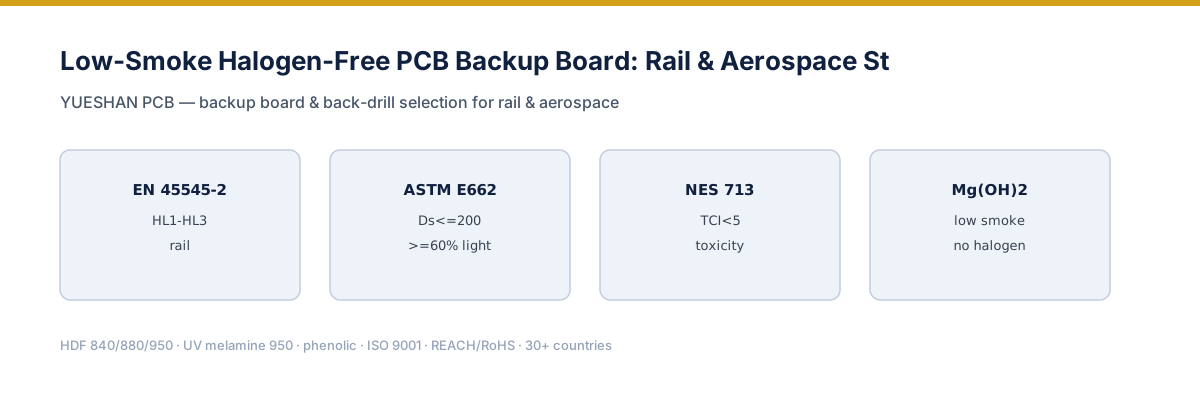
Low-smoke halogen-free backup board diagram
Fire-safety stack: halogen-free laminate plus a low-emission sealed support grade.
Material">Sealed

UV Melamine Backup

low-smoke Grade 950

UV melamine →
Material">HDF

HDF Backup Board

halogen-free-compatible

HDF →
Resource">Materials

Backup Board Materials

resin systems and CAF

materials →
Hub">Rail/Aero

Defense & Aerospace

matched low-emission grades

defense hub →
← Back to Blog Request Free Samples →

Frequently Asked Questions

YUESHAN supplies sealed halogen-free-compatible backup boards for rail and aerospace electronics. The questions below cover EN 45545-2, ASTM E662, NES 713 and IEC 60754 limits.

What fire-safety standards apply to a low-smoke halogen-free backup board?

EN 45545-2 grades rail materials by risk level (HL1 to HL3) with CO/HCN/HF limits; aerospace references FAR 25.853, ABD 0031 and BSS 7239; NES 713 sets a toxicity index for combustion; IEC 60754-1/2 limit halogen-acid gas. The backup board is one low-emission layer in that file.

What smoke-density and toxicity numbers should I check?

ASTM E662 (and IEC 61034-1) measure smoke density: Ds at or below 200 is the low-smoke benchmark and at least 60 percent light transmittance after burning passes; NES 713 keeps the toxicity index below 5 for halogen-free materials; IEC 60754 yields pH above 4.3 and conductivity below 10 micro-siemens per mm.

Which flame-retardant systems reduce smoke and toxicity?

Metal-hydroxide fillers — aluminium hydroxide (ATH) and magnesium hydroxide (Mg(OH)2) — release water vapour endothermically without toxic halogens; phosphorus-nitrogen systems can reduce smoke density and toxic gas by up to 60 percent during thermal decomposition (Andwinpcb). Use a sealed UV-melamine or coated HDF support to keep the board low-emission.

Is halogen-free the same as low-smoke?

Not exactly — halogen-free controls chlorine and bromine, while low-smoke and low-toxicity are measured by ASTM E662 and NES 713. A halogen-free build can still smoke; specify both the halogen-free status and the smoke/toxicity limits for rail and aerospace.

How does the backup board fit the rail or aerospace fire-safety file?

Confirm the laminate and ink ratings with the fabricator, then pair a sealed, halogen-free-compatible support grade; YUESHAN supplies the resin-system declaration so the file can be completed at the laminate plus consumable level.

Do you supply low-smoke halogen-free backup boards?

YUESHAN supplies sealed UV-melamine and halogen-free-compatible HDF grades with full material declarations for rail and aerospace electronics; request TDS and a sample to verify on your build.

LX

Mr. Lucky Xu — Director, YUESHAN PCB — Director, YUESHAN PCB

15 years in PCB drilling consumables. Wrote and technically reviewed this page; where a number is stated, the page says how it was measured, and any third-party or industry reference (IEC, IPC, MIL-STD, EN 45545, AEC-Q100, HilPCB, JLCPCB, Camptech II) is named inline rather than presented as a YUESHAN specification.

About the author · Editorial standards & review process · Request TDS / SDS or a sample