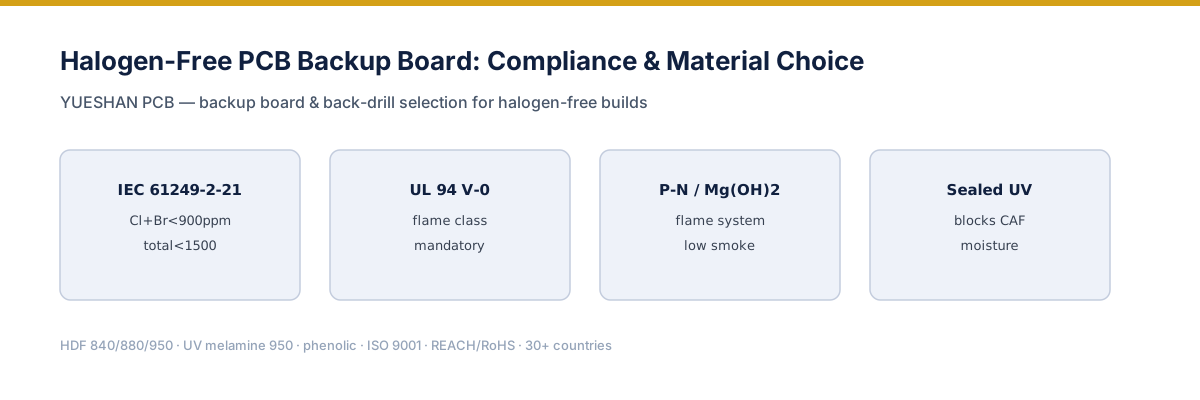
Short answer: A halogen-free backup board supports a halogen-free FR4 build by avoiding brominated and chlorinated additives in the support layer and by staying sealed against the moisture that can drive CAF. Specify to IEC 61249-2-21 (Cl plus Br below 900 ppm, total below 1500 ppm) and UL 94 V-0, and pair a sealed UV-melamine or HDF grade with the laminate rather than an open-fibre board.
Number: IEC 61249-2-21 sets the global halogen-free limit at Cl and Br each below 900 ppm and total halogen below 1500 ppm; some automotive and OEM programs tighten to 600 ppm per halogen (HilPCB, ipcb).
Boundary: Halogen-free governs the laminate and consumables together; the backup board is one layer. Confirm the laminate slash-HF status and the CAF strategy with the fabricator. See the backup board definition and the materials reference.

Halogen-free is no longer a niche request. Between RoHS 3.0, REACH and corporate sustainability targets, halogen-free FR4 has become the default for consumer, automotive and medical runs. But a halogen-free laminate only stays halogen-free if every layer in the stack is specified the same way — including the support board under the panel.
What halogen-free actually limits
The global benchmark is IEC 61249-2-21, reinforced by the IPC-4101B/D /HF suffix and JPCA-ES-01: a material qualifies as halogen-free when chlorine is below 900 ppm, bromine is below 900 ppm, and the two combined are below 1500 ppm. Some automotive and OEM programs (Apple, Tesla class) tighten the single-halogen limit to 600 ppm, so confirm the customer-specific limit before qualification.
Flame-retardant systems that are not halogenated
Conventional FR4 uses brominated epoxy; halogen-free laminates replace it with phosphorus-nitrogen or metal-hydroxide systems:
- Phosphorus-nitrogen: forms a char layer and, per Andwin, can reduce smoke density and toxic gas by up to 60% during thermal decomposition.
- Metal hydroxides: aluminium hydroxide (ATH) and magnesium hydroxide (MDH, Mg(OH)₂) release water vapour endothermically, delaying ignition without toxic halogens.
Why the backup board matters in a halogen-free build
| Risk in a halogen-free build | What the support grade should do |
|---|---|
| CAF growth from absorbed moisture | Use a moisture-sealed UV-melamine or coated HDF, not an open-fibre board |
| Undeclared halogen in the resin | Request the resin-system declaration; YUESHAN supplies REACH/RoHS and material declarations |
| Smoke or toxicity at end-of-life | Pair with a low-smoke laminate; melamine resin is nitrogen-based and inherently halogen-free |
Standards checklist
| Standard | What it controls |
|---|---|
| IEC 61249-2-21 | Halogen limits (Cl/Br <900 ppm, total <1500 ppm) |
| UL 94 V-0 | Flammability class |
| IPC-4101B/D (/HF) | Halogen-free laminate specification |
| JPCA-ES-01 | Asian halogen-free benchmark |
| RoHS 3.0 / REACH | Substance restriction and registration |
YUESHAN supplies halogen-free-compatible HDF and sealed UV-melamine backup grades with full material declarations. For the complete family map see the materials reference and the backup board definition.