Home / Blog / EV Battery PCB Entry Board

EV Battery PCB Drilling: Material Choices & Entry Board Selection

Entry Board Guide · 2026-10-31 · 6 min read

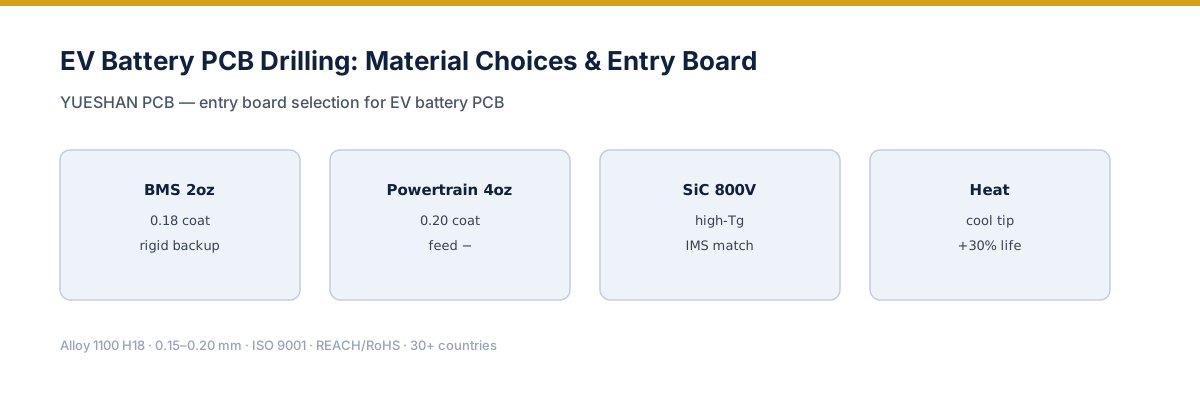
EV battery-management and powertrain PCBs combine heavy copper (2–4 oz+) with high-Tg and thermal substrates. Use a coated 1100 H18 entry (0.18–0.20 mm) to cool the bit on thick copper, a rigid backup for exit, and reduce feed on entry/exit; for IMS/aluminum-substrate boards match the entry to the dielectric layer.

EV power boards commonly carry 2 oz copper as a baseline and 4 oz or more for high-current stages; the same heavy copper that improves current capacity is what raises drilling force and bit temperature on every hole.

The entry board manages heat and location at the top of the stack; pair it with the right backup and a heavy-copper-qualified drill program. Heavy-copper drilling · entry board definition.

EV battery PCB drilling entry board material choices — YUESHAN 1100 H18 coated
YUESHAN coated entry board on an EV battery-management PCB drilling stack.

Electric-vehicle battery-management (BMS), powertrain and on-board-charger PCBs are power boards: they carry high current through thick copper on thermally demanding substrates. That combination — heavy copper plus high-Tg plus (often) an insulated-metal substrate — is exactly where entry and backup material choice decides hole quality.

What EV PCBs demand of the drill stack

Entry board for EV PCB

EV board typeRecommended entryBackup
BMS, 2 oz0.18 mm coated 1100 H18HDF / UV melamine, rigid
Powertrain, 4 oz+0.20 mm coated, feed −10–20%dense backup, replace before worn
SiC 800 V, high-Tgcoated matched to dielectric; IMS-seatedspecified per substrate

A coated entry board cools the bit and cuts smear on the thick copper, and on HDI/RF sections of the same board it tightens via location — one grade covering both the power and the control sections. YUESHAN coats 1100 H18 in 0.13–0.24 mm and supplies the matched backup family (HDF 840/880, UV melamine 950).

Drilling heavy copper and thermal substrates

Reduce feed 10–20% on entry and exit, deepen peck to clear chips from the thick copper, and qualify the bit-life interval on the actual stack. For insulated-metal substrates, match the entry thickness and flatness to the dielectric layer so the sheet seats without bridging the isolation gap. The heavy-copper playbook in the thick-copper guide applies directly here.

See also the automotive PCB drilling hub and the backup board guide for the matched material map.
EV battery PCB entry board selection diagram
EV board type → entry and backup choice for BMS and powertrain.
Material">Entry

1100 H18 Aluminum Entry

0.15–0.20 mm for EV copper

plain entry →
Material">Coated

Lubricant-Coated Entry

Cools bit on heavy copper

coated →
Guide">Heavy Cu

Thick Copper Drilling

Feed & backing for 4 oz+

heavy-copper →
Hub">Automotive

Automotive PCB Drilling

BMS / powertrain match

automotive →
← Back to Blog Request Free Samples →

Frequently Asked Questions

YUESHAN supplies 1100 H18 and coated aluminum entry boards, lubricant sheets and back-drill aluminum to power-electronics and BMS fabricators in 30+ countries since 2011. The questions below cover EV battery BMS PCBs (heavy copper + high-Tg).

What entry board for EV battery BMS PCBs (heavy copper + high-Tg)?

EV BMS and power boards combine heavy copper (3–5 oz / 105–175 µm, sometimes up to 20 oz) with high-Tg FR-4 (Tg ≥170 °C, for example Shengyi S1000-2M, Panasonic Megtron 4, Isola 370HR per AtlasPCB); use a coated aluminum entry board to cool the tip and a rigid backup to support the thick stack. YUESHAN supplies 1100 H18 and coated entry boards for this range.

Why is heavy copper a drilling challenge in BMS boards?

Heavy copper (AtlasPCB: 3–5 oz for 50–200 A bus bars) raises cutting force and tip heat and coarsens minimum trace/space, so entry heat control and exit support matter more; standard FR-4 (Tg130) also cycles through Tg in under-hood heat and risks via fatigue, which is why high-Tg is specified.

What substrate/Tg should an EV BMS PCB use?

Use high-Tg FR-4 (Tg170) such as Shengyi S1000-2M as the baseline, stepping to Tg180+ (Panasonic Megtron 4, Isola 370HR) near the cell interface for thermal margin; polyimide or aluminum-oxide substrates are options for extreme heat. The entry board must drill these filled laminates cleanly.

How does the entry board help EV power-board thermal reliability?

A coated aluminum entry reduces tip temperature and resin smear on high-Tg, filler-rich stacks, protecting via-barrel integrity through 1,000+ thermal cycles (−40 to +125 °C, AEC-Q100 Grade 0/1). It is one layer of a qualified, grade-locked stack alongside backup and drill program.

What standards apply to EV BMS PCBs?

IPC-6012 Class 3 with full traceability, IATF 16949, AEC-Q100/101/200, and ISO 26262 functional safety (WonderfulPCB, AtlasPCB); 800V systems need high dielectric strength and CAF resistance. YUESHAN supplies entry boards referenced to this automotive/electrical practice with TDS and COA.

Do you supply entry boards for EV battery and 800V BMS PCBs?

YUESHAN supplies 1100 H18 and coated aluminum entry boards, lubricant sheets and back-drill aluminum to power-electronics and BMS fabricators in 30+ countries since 2011; request a free sample and TDS to qualify on your 400–800V BMS stack.

LX

Mr. Lucky Xu — Director, YUESHAN PCB — Director, YUESHAN PCB

15 years in PCB drilling consumables. Wrote and technically reviewed this page; where a number is stated, the page says how it was measured, and any third-party or industry reference (Chalco, GoPCBA, IPC) is named inline rather than presented as a YUESHAN specification.

About the author · Editorial standards & review process · Request TDS / SDS or a sample