Home / Blog / Cost-Effective Entry Board

Cost-Effective Entry Boards for Consumer & IoT PCB: Total Cost, Not Unit Price

Entry Board Guide · 2026-10-31 · 6 min read

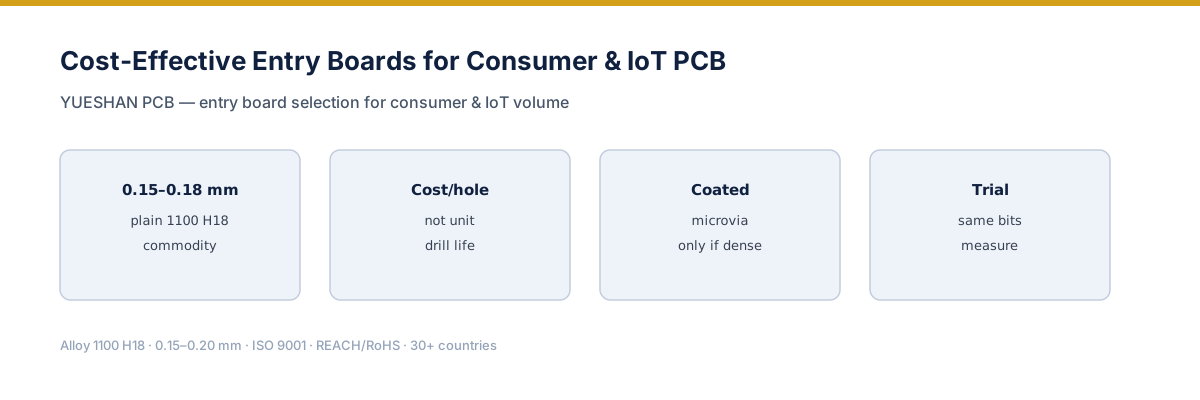
For high-volume consumer and IoT boards, plain 1100 H18 at 0.15–0.18 mm is the commodity default. Judge it on cost per hole — drill life, scrap and throughput — not the sheet price, and step up to coated only where microvia density demands it.

A 30%+ micro-drill life extension on dense boards is usually the largest line item; fewer regrinds, fewer changeovers and fewer rejected panels often dwarf the foil unit price on commodity runs.

Do not qualify a new material blind. Run a side-by-side trial on the same program and same bits, switching only the entry sheet, and measure burr, bit wear and location. Entry board definition · thickness guide.

Cost effective aluminum entry board for consumer and IoT PCB — YUESHAN 1100 H18
YUESHAN 1100 H18 entry board on a high-volume consumer PCB drilling line.

Consumer and IoT boards are produced in the millions, so every cent of the drilling consumable gets scrutinised. The trap is judging the entry sheet on its sticker price: the sheet is consumed once per panel, but the drill bit, the scrap and the throughput decide the real cost per hole.

The unit-price trap

A cheaper entry sheet saves a few cents per panel and can cost far more in rework. Model the whole cost:

Plain 1100 H18 is the commodity default

For general consumer and IoT drilling the baseline is plain 1100 H18 in 0.15–0.18 mm (alloy 1100, ≥99% aluminum, H18 full-hard temper). It is cost-effective, widely available, and sufficient for the majority of standard multilayer and IoT boards. YUESHAN ships ISO 9001 1100 H18 with full TDS/MSDS to 30+ countries.

Your board profileRecommended entryWhy
2-layer consumer, large holes0.18 mm plain 1100 H18lowest cost per panel
IoT HDI, fine pitch0.13–0.15 mm coatedcools bit, holds location on microvia
High-volume stacked0.20 mm plain, raise panelsmore rigid, supports tall stack

When to step up from plain

Coated entry boards are not a universal upgrade. Below Ø0.15 mm, or on HDI/BGA/IC-substrate work, the coating cools the tip and tightens location enough to pay for itself. Phenolic is only worth it on coarse, large-hole, low-layer work where tolerance is loose and sheet price dominates. Step up per product family, not plant-wide.

Match the grade with the entry board selector and read the aluminum vs phenolic comparison before changing materials.
Cost-effective entry board selection diagram
Cost per hole model: sheet price vs drill life, scrap and throughput.
Material">Entry

1100 H18 Aluminum Entry

0.15–0.20 mm commodity default

plain entry →
Material">Coated

Lubricant-Coated Entry

HDI / microvia upgrade

coated →
Tool">Selector

Entry Board Selector

Match grade to hole & layer

selector →
Guide">Compare

Aluminum vs Phenolic

Where phenolic still wins

compare →
← Back to Blog Request Free Samples →

Frequently Asked Questions

YUESHAN supplies 1100 H18 and coated aluminum entry boards to high-volume fabricators in 30+ countries since 2011. The questions below cover the lowest-total-cost entry-board choice for consumer and IoT PCBs.

What is the cheapest acceptable entry board for high-volume consumer and IoT PCBs?

A 0.15–0.18 mm 1100 H18 plain aluminum entry board is the commodity default; YUESHAN's own thickness guide shows 0.15 mm runs about 15% below the 0.18 mm baseline on a per-1000-sheets basis. Reserve phenolic only for coarse, large-hole, low-layer work where location tolerance is loose.

Is the lowest entry-board price the lowest total cost?

Not always — total cost per good hole includes drill-bit life and scrap, not just sheet price. YUESHAN's data shows the slightly higher bit life on 0.20 mm offsets part of its material premium, while the wrong thickness (for example 0.20 mm on a 0.20 mm drill) can cut bit life 30–50%. A total-cost model beats chasing the lowest sheet price.

How much does an aluminum entry board cost per sheet?

Published export listings (DXE via EveryChina/MachineU) show lubricated 1100-family entry sheets around USD 2.70–3.00 per sheet at MOQ about 4,000 sheets, 0.07–0.18 mm; YUESHAN quotes per thickness, coating and order volume with TDS/MSDS. Confirm current pricing with a request-for-quote, since alloy and coating change the number.

When is phenolic entry board good enough instead of aluminum?

For standard FR-4, large holes (≥0.30 mm) and few layers where land tolerance is loose, phenolic is acceptable and cheaper per sheet. For HDI, multilayer and any fine-pitch work, aluminum's self-centring gives better location and longer bit life, which usually wins on total cost.

What thickness should I standardize for consumer/IoT volume drilling?

Standardize on 0.18 mm for most multilayer consumer/IoT work; step down to 0.15 mm (or a lubricated LE sheet) for HDI microvia (≤0.15 mm); move up to 0.20 mm for thick panels (≥3.2 mm) and back-drill. YUESHAN's decision matrix maps thickness to drill size and layer count.

Do you supply cost-effective entry boards for high-volume IoT fabs?

YUESHAN supplies 1100 H18 and coated aluminum entry boards with free worldwide samples and TDS to validate total cost per hole on your line before you standardize.

LX

Mr. Lucky Xu — Director, YUESHAN PCB — Director, YUESHAN PCB

15 years in PCB drilling consumables. Wrote and technically reviewed this page; where a number is stated, the page says how it was measured, and any third-party or industry reference (Chalco, GoPCBA, IPC) is named inline rather than presented as a YUESHAN specification.

About the author · Editorial standards & review process · Request TDS / SDS or a sample