Automotive PCBs run from −40 °C to +150 °C by grade and must hold for 15+ years, so entry boards are matched to the temperature class and layer profile: 0.18 mm 1100 H18 default, coated for HDI/ADAS fine vias, rigid backup for exit. Materials carry IATF 16949, high-Tg ≥170 °C, and CAF resistance.
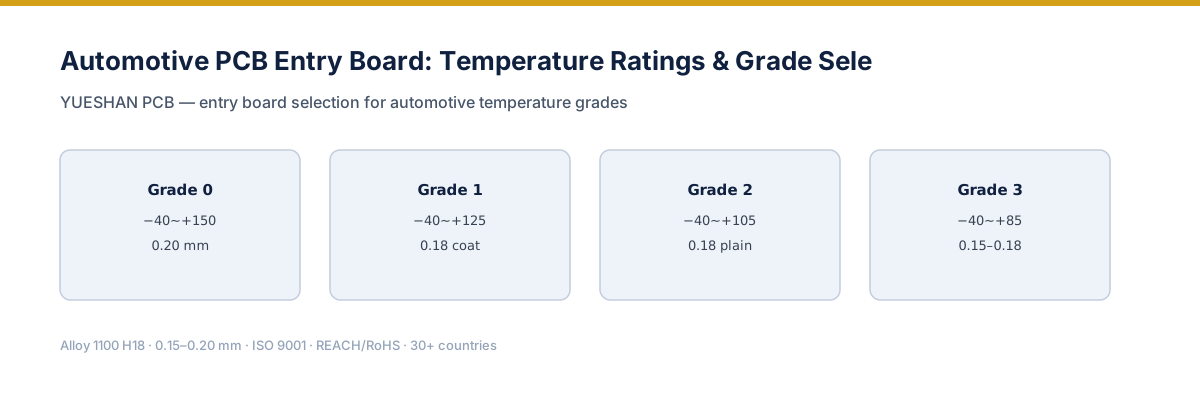
Automotive temperature grades: Grade 0 −40 to +150 °C (engine bay), Grade 1 −40 to +125 °C, Grade 2 −40 to +105 °C (cabin), Grade 3 −40 to +85 °C (infotainment); minimum substrate Tg is 170 °C for car-grade boards.
The entry board is one layer of a qualified automotive stack; pair it with the right backup and drill program and keep grade-locking so the qualified set never drifts. Automotive PCB drilling · entry board definition.

Automotive electronics must be reliable for 15+ years across −40 °C to +150 °C and survive vibration and humidity — a bar far above consumer grades. The entry board is selected to that temperature class and the board's layer profile, not by habit.
Automotive temperature grades
| Grade | Range | Use | Entry default |
|---|---|---|---|
| Grade 0 | −40 to +150 °C | engine bay | 0.20 mm, coated where dense |
| Grade 1 | −40 to +125 °C | engine bay / exterior | 0.18 mm, coated for ADAS |
| Grade 2 | −40 to +105 °C | passenger cabin | 0.18 mm plain 1100 H18 |
| Grade 3 | −40 to +85 °C | infotainment / body | 0.15–0.18 mm plain |
Entry board role in automotive stacks
Automotive boards are typically 4–8 layers at Grade 2/3 and 6–24 layers for ADAS and powertrain. The entry board still does the three jobs — guide, cool, suppress burr — but the tolerance bar is higher because a location error costs far more in a car than in a toy:
- 0.18 mm 1100 H18 is the default across most automotive stacks (standard FR-4, high-Tg, mid-range telecom).
- Coated aluminum is stepped up for ADAS, radar and HDI where fine vias need bushing-grade location; the coating cools the bit and tightens accuracy.
- Rigid backup (HDF / UV melamine) supports the exit so the bottom copper does not tear under vibration and thermal cycling.
Standards the program expects
Car-grade boards are built to IATF 16949 with the IPC-6012DA automotive appendix, UL 94 V-0 flammability, and CAF resistance; substrate minimum Tg is 170 °C and copper plating is ≥25 µm in vias. YUESHAN supplies the entry and backup consumables against that same quality system, with REACH/RoHS declarations and per-lot traceability.
See the automotive PCB drilling hub and the entry board thickness guide for the matched material map.